Building an AI-Ready Data Organization: Lessons from Enterprise Deployments

Artificial intelligence is a game-changer. For many executives, the question is no longer whether to adopt artificial intelligence but how to build an organization where AI can survive. Organizations worldwide are rapidly deploying AI systems to gain competitive advantage, improve operational efficiency, and enhance customer experiences. However, the journey from AI experimentation to sustainable, enterprise implementation reveals a critical gap: most organizations fail to build the foundational data and governance infrastructure necessary to maximize AI value.
Research from 2025 shows that 95% of organizations generate zero returns from $30-40 billion in generative AI investments due to inadequate governance infrastructure and inadequate implementation discipline.
Building an AI-ready organization is like building a championship sports team. You can hire the most expensive superstar player (the fancy AI), but if the team lacks a playbook, reliable training equipment, and a unified goal, the superstar won’t win any games.
This article uses real-world enterprise examples to demonstrate how organizations have established AI-ready data infrastructures.
The Pre-AI Reality: Challenges Enterprises Face
Before implementing comprehensive AI solutions, organizations operate within significant constraints. Legacy systems operate in silos, creating fragmented data landscapes where insights remain trapped in departmental databases. Manual decision-making processes consume weeks or months. This timeframe doesn’t align with the speed required of today’s fast-paced business world. Customer support teams struggle with high call volumes; field service teams optimize routes manually; supply chain managers rely on spreadsheets; and quality control inspectors perform repetitive visual inspections in manufacturing environments.
According to recent research, 58% of enterprises struggle to integrate fragmented systems, while 55% are experiencing issues automating manual processes. These operational bottlenecks translate directly to financial impact: high operational costs, delayed decision-making, lower employee productivity, reduced customer satisfaction, and missed revenue opportunities.
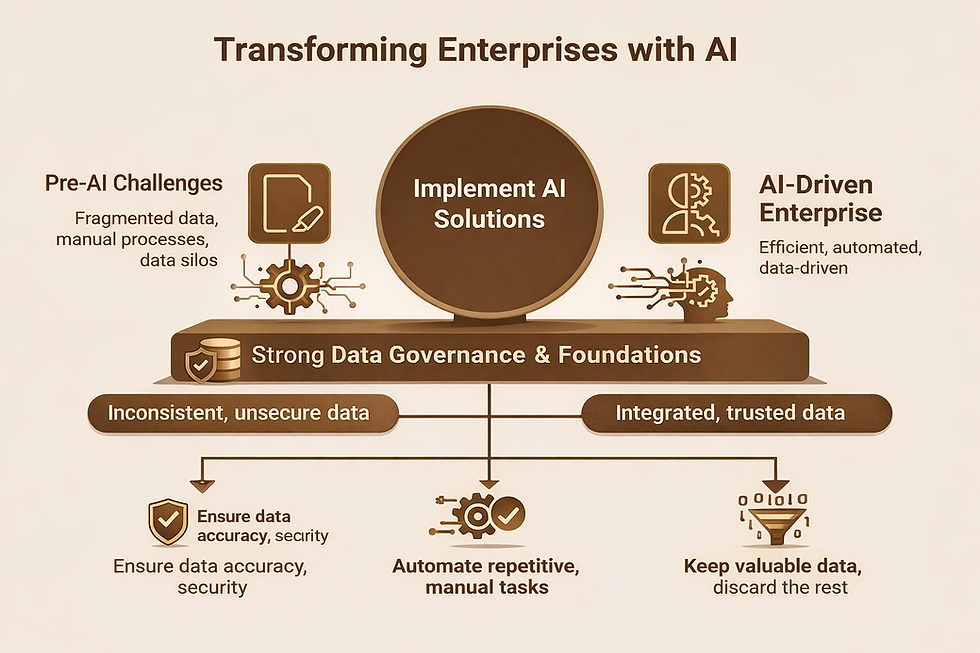
Governance: Building Trust and Compliance into Data
What It Means:
Governance is about rules and standards. It ensures data is accurate, secure, and easy for the right people to find and use. Without this, AI gets confused by bad or conflicting information. If your data is messy, your AI’s decisions will be messy. This leads to bad strategies, wasted money, and missed opportunities. Good governance is the unbreakable foundation.
Below are 2 real case studies of how major enterprises solved their data chaos problems through strong governance.
Case Study 1: AT&T - Transforming a Telecom Giant’s Core Asset
Industry: Telecommunications
The Core Problem: The Customer Churn MysteryAT&T had hundreds of millions of customer interactions across billing, network calls, support chats, and retail stores. This data was fragmented across dozens of legacy systems. As a result, they had an incomplete view of their customers. When a customer called to cancel service (“churn”), it was often a surprise. The retention team had no clear insight into the warning signs maybe slow network speeds for weeks, multiple billing calls, or a competitor’s promotion that led to the cancellation.
The Governance Solution: The “Customer 360” MandateThe CEO and CTO championed a “Customer 360” program as a top strategic goal. This was a governance-driven business initiative.
Master Customer Identifier: The first rule was to create and enforce a single, unique ID for every customer across all systems. This linked their billing, network usage, and support history.
Standardized Journey Stages: They defined universal stages of the customer journey (e.g., “onboarding,” "at-risk,” "loyal”). All teams had to tag data with these stages.
Centralized Data Platform (CDP): They built a governed Customer Data Platform that ingested data from all sources, applying strict rules for matching and merging customer records to create one accurate profile.
Business Impact & Leadership Insight:
Slowed Customer Churn: With a complete view, their AI models could identify customers at high risk of leaving with over 85% accuracy. This allowed retention teams to intervene proactively with targeted offers, reducing churn by a significant percentage.
Personalized Marketing: Marketing could finally run truly personalized campaigns, knowing a customer’s full history, leading to higher conversion rates.
Operational Efficiency: Customer service agents had the full story the moment a customer called, drastically reducing call handle times and improving satisfaction.
Executive Takeaway: Governance is the key to customer-centricity. You cannot put the customer at the center of your business if your data is fragmented. Governing customer data to create a single, authoritative view is perhaps the highest-return governance investment a customer-facing company can make.
Case Study 2: JPMorgan Chase
Industry: Banking & Financial Services
Core Problem: Regulatory Overload and Cost As one of the world’s largest banks, JPMorgan processes trillions of dollars in transactions daily. Regulations require keeping certain records for 5, 7, or even 10 years. The problem was that "keep everything" was exploding storage costs and made it nearly impossible for analysts to find the correct data for risk modelling or customer service.
The Retention Solution: The “Three-Tier” Data Lake with Automated LifecyclesThe bank moved away from scattered storage to a governed central data platform. They tagged every piece of data with three key attributes:
Business Value: How critical is this for trading, risk analysis, or customer insights?
Regulatory Requirement: What is the legal minimum retention period (e.g., 7 years for trade records)?
Access Frequency: Is this data used daily, or is it a historical archive?
They then created three automated tiers:
Tier 1 (Hot - Keep Detail): High-value, frequently used data (last 90 days of trading data, active customer profiles) and kept in full detail for real-time AI and analytics.
Tier 2 (Warm - Keep Summary): Older data needed for monthly reporting or model training. Raw data was compressed, and key summaries were kept.
Tier 3 (Cold - Archive or Delete): Data past its regulatory life. The system automatically encrypted and moved it to ultra-low-cost archive storage or, if allowed, securely deleted it.
Business Impact & Leadership Insight:
Cost Savings: Reduced annual data storage and management costs by an estimated 30-40%, saving hundreds of millions of dollars.
Risk Reduction: Automated compliance lowered legal and regulatory fines.
AI Acceleration: Data scientists could now find clean, high-quality datasets faster, cutting the time to build new fraud detection models by over 50%.
Executive Takeaway: lever. By tying data lifecycles directly to business value and regulation, you turn a cost center into a source of efficiency and security.
Why Leaders Care:
Storing useless data is a waste of money. Keeping sensitive data too long is a legal and security risk. Being selective helps your AI focus on what matters, making it faster and more accurate.
C-Suite Alignment: Getting Leadership on the Same Page
The main issue with C-suite alignment is that Tech teams often “code” while CEOs speak of “money.” The gap that is created causes the projects to fail. So the main idea is not about selling AI as “magic”. We should sell it as a tool to solve business problems.
The Mindset that makes Organizations AI-ready:
Across these case studies, there is a consistent pattern to note. The common mindset is:
They treated the data as their primary driving factor
They focus on defining the problem before model building
They invest in governance at an early stage
For them, success is the outcome, not technological advancement.
Conclusion
Building an AI-ready data organization isn’t about chasing the latest technology. It’s about creating the conditions where AI can be trusted, adopted, and scaled responsibly.
From what I’ve seen, the enterprises that succeed focus less on being “AI-first” and more on being decision-first. They build governance that enables confidence, analytics that drive action, and leadership alignment that turns insight into impact.


Comments